No Receipt, No ITC: What CRA Requires
If your business is GST/HST-registered, every dollar of GST or HST you pay on business expenses can be recovered as an Input Tax Credit — but only if you have the receipt to prove it. This is what CRA requires, and what happens when you don't have it.
What Is the Rule on ITC Documentation?
Under the Excise Tax Act, claiming an Input Tax Credit (ITC) requires that you have documentary evidence to support the claim. That evidence must exist at the time you file your GST/HST return. If CRA audits your ITC claims and you cannot produce the supporting documentation, the ITC is denied — and you may owe the amount back plus interest.
There is no appeal on the basis of "I know I paid HST on that expense." Without the receipt, the ITC does not exist.
What Documentation Does CRA Require for ITC Claims?
For purchases under $100: the document must show the supplier's name, the invoice date (or the date the tax was paid), and the total amount paid.
For purchases of $100 to $499.99: all of the above, plus an indication of the GST/HST charged (or that the total includes it) and the supplier's GST/HST registration number.
For purchases of $500 and over: all of the above, plus the buyer's name, a brief description of the goods or services, and the terms of payment.
The most common reason ITCs are denied: a receipt for a purchase of $100 or more that does not show the supplier's GST/HST registration number.
What Counts as Acceptable Documentation for CRA?
CRA accepts original paper receipts, electronic receipts (email receipts, PDF invoices), and photographed images of paper receipts. A clear, legible photo of a receipt taken on a smartphone satisfies CRA's documentation requirements — provided it includes all required fields and is legible.
Bank statements and credit card statements alone do not qualify. They show that a payment was made; they do not show what was purchased or whether HST was charged. CRA specifically states that bank statements are not acceptable as standalone ITC documentation.
Why Do Receipts Disappear Before the 6-Year Window Closes?
Thermal paper — used by most point-of-sale receipt printers — fades within 2–5 years under normal storage conditions. CRA requires businesses to keep records for 6 years. A 2024 restaurant receipt stored in a filing cabinet may be completely blank by 2028 — well within the audit window.
The solution is to photograph every receipt at the point of purchase and store the image digitally. A legible digital image satisfies CRA's requirements and does not degrade.
How Does Nabbit Prevent Lost Input Tax Credits?
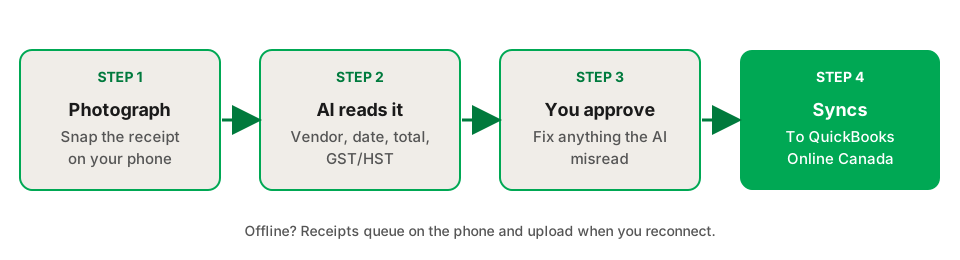
Nabbit captures the receipt image at the moment of purchase, extracts the vendor name, amount, date, and HST amount, and stores the full-resolution image in a secure archive. Every receipt is indexed by date, vendor, and amount — making CRA audit preparation a matter of seconds.
The GST and HST amount is also coded separately before syncing to QuickBooks Online Canada. At quarter end, your ITC total is already in QuickBooks — no spreadsheet required.
What Does a Denied ITC Actually Cost Your Business?
The dollar impact of missing receipts is easy to underestimate until you do the math. In Ontario, HST is 13%. A $500 supply purchase has $65 in recoverable HST — gone if the receipt is missing. A $2,000 equipment rental has $260 in ITCs at stake.
For a general contractor spending $8,000 per month on materials in Ontario, that is $1,040 in HST per month, or $12,480 per year in ITCs available. A systematic gap of even 20% in receipt retention — not unusual for businesses that rely on paper — costs $2,496 in recoverable tax that is simply left with CRA.
In Alberta, where the rate is 5% GST, the per-transaction amounts are smaller but the principle is the same: every missing receipt permanently forfeits the tax recovery on that purchase. Across a year of business spending, the total adds up to a material cash-flow impact.
When CRA denies ITCs during an audit, it also assesses interest from the original filing date — not from the audit date. A denied ITC on a 2022 return audited in 2026 carries four years of compound interest on top of the denied amount.
What Happens When CRA Audits Your ITC Claims?
A GST/HST audit begins with a written request — sometimes called an audit engagement letter — that identifies the period under review and the documentation CRA wants. You typically have 30 days to respond with the requested records.
The auditor reviews each ITC claimed and requests the supporting receipt for specific transactions. If you cannot produce it, the ITC is denied and added to your balance owing. If the amounts are material, CRA may also assess a penalty in addition to interest.
The burden of proof is entirely on the registrant. CRA does not accept verbal confirmation, bank statements, or reconstructed logs as substitutes for the original receipt. If your records are stored as digital images in an organised archive, audit preparation typically takes hours. If they are in a shoebox or filing cabinet, it can take weeks — and some will be unreadable regardless.
Which Situations Cause Receipts to Go Missing Most Often?
Job-site purchases. A contractor stops at a hardware store, tucks the receipt in a jacket pocket, and it is lost, washed, or discarded before it makes it to the office. The HST on a $400 lumber run — $52 in Ontario — disappears with it.
Team and employee expenses. An employee submits an expense report and hands over the paper receipt. The receipt gets separated from the report in handling and is never filed. The ITC claim survives in QuickBooks but the supporting document does not.
Thermal paper degradation. Fuel receipts, POS restaurant receipts, and most retail receipts are printed on thermal paper that fades within two to four years at room temperature. A receipt stored in a filing cabinet in 2023 may be blank by the time a 2023 audit is triggered in 2027.
Online vendors without Canadian HST registration. A business purchases software or services from a foreign vendor that has not registered for HST in Canada. The invoice does not show a Canadian GST/HST registration number. Even with a complete receipt, no ITC can be claimed — because the vendor did not charge Canadian tax. Checking vendor registration status before purchase prevents the disappointment of an invoice that looks complete but cannot support an ITC.
Never lose an ITC again
Nabbit captures receipts, stores them for CRA's 6-year requirement, and tracks GST/HST automatically.
Start Free Trial →Sources
The rules on this page come from these Canada Revenue Agency publications. Check them for the current wording, because CRA updates its guidance.
- Input tax credits, Canada Revenue Agency
- RC4022 General Information for GST/HST Registrants, Canada Revenue Agency
- RC188 Keeping Records, Canada Revenue Agency