How Long Do You Need to Keep Business Receipts in Canada?
Six years from the end of the tax year they relate to. This is the CRA rule that applies to virtually all business records, including receipts, invoices, expense reports, and supporting documentation.
If your business fiscal year ends December 31, 2024, you must keep all 2024 receipts until at least December 31, 2030.
What Is the Full CRA Rule on Record Retention?
Section 230 of the Income Tax Act requires that records be kept for a minimum of six years from the end of the last tax year to which they relate. For GST/HST purposes, the Excise Tax Act applies the same six-year rule to all records related to ITC claims. There is no distinction between paper and digital receipts — a photographed receipt stored digitally satisfies CRA's requirement provided it is legible and includes the required fields.
When Do You Need to Keep Records Longer Than Six Years?
Keep receipts longer when:
- A return is under objection or appeal — keep all records until the appeal is resolved plus six years.
- Capital assets — keep records for the asset (purchase receipt, invoices) for six years after you sell, scrap, or dispose of it; not six years from purchase.
- Partnership records — if you are in a partnership, records related to the partnership's fiscal years must be kept for six years after the partnership ends.
- Fraud or misrepresentation — if CRA opens a case for fraud, there is no time limit on how far back they can go.
Why Are Paper Receipts a Problem for the CRA 6-Year Retention Requirement?
CRA's 6-year retention requirement creates a practical problem: paper receipts degrade. Thermal paper — used by most point-of-sale printers — fades within 2–5 years under normal storage conditions. A 2024 restaurant receipt stored in a filing cabinet may be unreadable by 2028. If CRA audits your 2024 returns in 2029 (within the 6-year window) and your receipts are blank, they are the same as no receipts at all — the expense and ITC will be denied.
What Is the Best Way to Preserve Receipts for the Full Six Years?
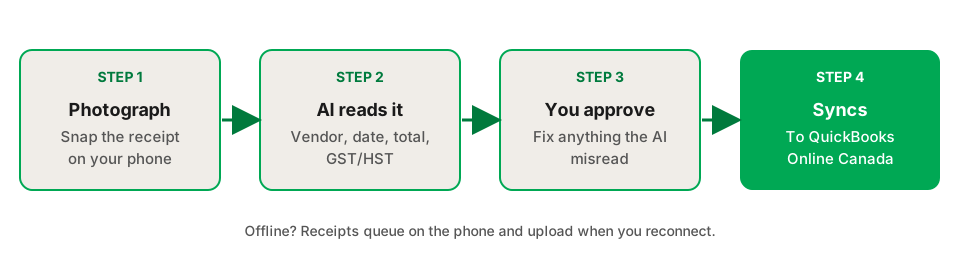
Photograph or scan every receipt at the time of purchase. A clear, legible digital image satisfies CRA's documentation requirement and does not fade. Nabbit captures receipt images on your phone, stores them at full resolution, and indexes them by date, vendor, and amount — making CRA audit preparation a matter of seconds rather than hours of filing cabinet archaeology.
What Happens If CRA Audits and Your Receipts Are Missing or Unreadable?
If CRA selects a year for audit and your supporting receipts are missing, unreadable, or cannot be produced within the audit's response window, the expenses and Input Tax Credits associated with those receipts are denied. You owe the disallowed ITC amount plus interest calculated from the original filing date.
For a small business with $300,000 in annual taxable expenses in Ontario (13% HST), the total recoverable HST is approximately $39,000 per year. If even 15% of those receipts are unavailable at audit time — roughly the rate for businesses relying on paper — the exposure is nearly $5,850 in denied ITCs for a single year, plus interest. Across multiple audit years, the amounts compound quickly.
CRA does not accept reconstructed records as a substitute for originals. A list of transactions from a bank statement tells CRA what you paid, not what you bought or whether HST was charged. Only the original receipt — paper or a legible digital image — satisfies the Excise Tax Act's documentation standard.
How Should the Six-Year Window Be Calculated for Each Receipt?
The clock starts at the end of the last tax year the receipt relates to — not the date of the receipt itself. For a business with a December 31 fiscal year end, a receipt dated March 15, 2024 relates to the 2024 tax year. The tax year 2024 ends December 31, 2024. The six-year window ends December 31, 2030.
A receipt dated December 31, 2024 and a receipt dated January 1, 2024 are both in the 2024 tax year for a December 31 fiscal-year-end business and must both be retained until December 31, 2030. The specific date within the year does not shorten the window.
For a business with a March 31 fiscal year end, receipts from the period April 1, 2023 to March 31, 2024 relate to the 2024 fiscal year. That year ends March 31, 2024. The six-year window ends March 31, 2030. The retention end date follows the fiscal year end — not the calendar year.
Home office expenses are worth noting separately. If your business deducts a portion of home operating costs (utilities, internet, insurance), the receipts for those costs — your utility bills, insurance policies — must be retained for the same six-year period even though they are household expenses. CRA can ask for them if the home office deduction is queried.
What Are CRA Retention Periods by Document Type?
| Document type | Keep for |
|---|---|
| Business receipts and invoices | 6 years from end of tax year |
| GST/HST records and ITC documentation | 6 years from end of fiscal year |
| Payroll records | 6 years |
| Capital asset records | 6 years after disposal |
| Corporate minute books and share registers | Permanently (for corporations) |
Store receipts digitally — CRA-compliant for 6 years
Nabbit captures and archives your receipts at full resolution. Never worry about a faded thermal receipt again.
Start Free Trial →Sources
The rules on this page come from these Canada Revenue Agency publications. Check them for the current wording, because CRA updates its guidance.
- Where to keep your records, for how long, and how to request permission to destroy them early, Canada Revenue Agency
- RC188 Keeping Records, Canada Revenue Agency
- Input tax credits, Canada Revenue Agency