What Receipts Do You Need to Keep for CRA?
If the Canada Revenue Agency audits your business, the burden of proof is on you. Expenses that cannot be substantiated with appropriate documentation are denied — and if the amounts are material, so are the GST/HST Input Tax Credits (ITCs) associated with them.
What Receipts Does CRA Require You to Keep?
CRA requires that you keep supporting documentation for all business expenses you deduct from income and all GST/HST ITCs you claim. Keep a receipt or invoice for every expense and every ITC you claim. For ITC claims, the details the document must show depend on the purchase amount, as set out below.
What Makes a Receipt Valid for CRA?
A valid business receipt must include:
- Vendor name and address (or sufficient information to identify the supplier)
- Date of the transaction
- Amount paid (including the amount before tax)
- GST/HST registration number of the vendor (required for ITC claims on purchases of $100 or more)
- Description of the goods or services purchased
- Amount of GST/HST charged (for purchases of $100 or more where you are claiming an ITC)
For purchases under $100, the supporting document must show the supplier's name, the invoice date, and the total paid. From $100 to $499.99 it must also show the GST/HST charged (or that the total includes it) and the supplier's GST/HST registration number. At $500 and over it must also show the buyer's name, a brief description of the goods or services, and the payment terms.
What Are the CRA Rules on Full vs. Simplified Invoices?
CRA sets three documentation levels based on the purchase amount:
Under $100: Supplier name, invoice date (or the date the tax was paid), and total amount paid.
$100 to $499.99: All of the above, plus an indication of the GST/HST charged (or that the total includes it) and the supplier's GST/HST registration number.
$500 and over: All of the above, plus the buyer's name, a brief description of the goods or services, and the terms of payment.
If you want to claim the ITC on a $200 business lunch and the restaurant receipt does not show the vendor's GST/HST registration number, CRA can disallow the ITC. This is one of the most common reasons ITCs are denied on audit.
What Counts as Acceptable Documentation?
CRA accepts: original paper receipts; electronic receipts (email receipts, PDF receipts from vendors); and photographed images of paper receipts. Digital images of receipts are fully accepted by CRA, provided the image is legible and includes all required fields.
Credit card statements and bank statements alone do not qualify. They show that a payment was made — not what was purchased or whether HST was charged. CRA does not accept them as standalone ITC documentation.
Which 6 Expense Categories Does CRA Scrutinise Most?
- Meals and entertainment — must show the business purpose and who attended. CRA limits deductibility to 50% of eligible expenses.
- Vehicle expenses — a mileage log is required in addition to fuel and maintenance receipts. Without a log, CRA can disallow the entire vehicle expense deduction.
- Home office expenses — receipts for home costs need to be allocated to a business-use percentage; a T2200 or reasonable calculation is required.
- Client gifts — subject to the 50% entertainment rule; documentation of the business purpose is required.
- Travel expenses — hotel folios, airfare, car rental, and meal receipts should show dates, destinations, and business purpose.
- Contractor payments — invoices from contractors should show the contractor's GST/HST registration number if they are charging HST.
What Happens When a Receipt Is Missing the HST Registration Number?
For any purchase of $100 or more, the HST registration number is not optional — it is the field that proves the vendor was registered for HST and that HST was legitimately charged. If the number is absent, CRA treats the transaction as unsubstantiated and denies the ITC, even if every other field on the receipt is complete and the expense was unambiguously a business expense.
This comes up most often with newer suppliers, sole proprietors, or international vendors billing into Canada. A supplier with under $30,000 in annual revenue is not required to register for GST/HST and therefore cannot charge it — meaning there is no ITC to claim on their invoices regardless of how complete the receipt is. Before paying a large invoice, confirm that the vendor's HST registration number appears on the invoice. You can verify any registration number at the CRA GST/HST Registry at canada.ca.
For meals and entertainment, the 50% deductibility limit is an income tax rule, not a GST/HST rule. You can still claim the full ITC on the HST portion of an eligible business meal — CRA allows 100% of the HST back as an ITC, even though only 50% of the expense itself is deductible for income tax purposes. The receipt must include the vendor's HST number (if $100 or more), the date, the total, and ideally the names of attendees and business purpose noted on the back.
How Long Do You Need to Keep Business Receipts?
Six years from the end of the tax year they relate to. If your fiscal year ends December 31, 2024, you must keep 2024 receipts until at least December 31, 2030. Keep older receipts if a return is still under objection or appeal, or if the receipt relates to a capital purchase — keep those for 6 years after you sell or dispose of the asset.
CRA Receipt Requirements at a Glance
| Requirement | Under $100 | $100–$499.99 | $500 and over |
|---|---|---|---|
| Supplier name | ✓ Required | ✓ Required | ✓ Required |
| Invoice date | ✓ Required | ✓ Required | ✓ Required |
| Total paid | ✓ Required | ✓ Required | ✓ Required |
| GST/HST charged (or included) | — | ✓ Required | ✓ Required |
| Supplier GST/HST registration number | — | ✓ Required | ✓ Required |
| Buyer's name | — | — | ✓ Required |
| Description of goods or services | — | — | ✓ Required |
| Terms of payment | — | — | ✓ Required |
Source: Input tax credits, Canada Revenue Agency.
Capture CRA-compliant receipts automatically
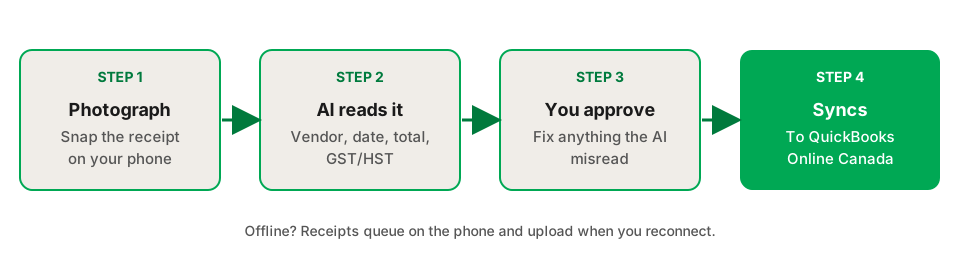
Nabbit photographs receipts, extracts the required fields, and stores images for CRA's 6-year retention requirement.
Start Free Trial →Sources
The rules on this page come from these Canada Revenue Agency publications. Check them for the current wording, because CRA updates its guidance.
- Input tax credits, Canada Revenue Agency
- RC4022 General Information for GST/HST Registrants, Canada Revenue Agency
- RC188 Keeping Records, Canada Revenue Agency